What Does Boron Do in Hazelnuts?
Boron is a micronutrient the plant needs only in gram quantities — yet its importance is inversely proportional to that quantity. In Eti Maden’s publications on boron nutrition, boron’s best-known physiological role is defined as its part in the plant’s generative (reproductive) growth: boron is specifically involved in pollen viability, pollen germination and pollen tube formation. The same source states that, most likely because of its effect on cell wall formation and function, boron is absolutely essential for the synthesis and development of the pollen tube, which plays a critical role in fertilization.
For the hazelnut grower this translates into:
- The chemistry of fertilization depends on boron. Even if pollen reaches the cluster, an insufficient boron supply keeps the pollen tube from reaching the ovary.
- It builds cell walls. In young shoots and growing points it ensures the tissue is assembled properly.
- It helps transport calcium and fix it into the tissue. Without boron, calcium does not reach the right place even when the orchard has plenty of it.
- It takes part in the formation and transport of carbohydrates — which directly concerns kernel filling.
The most striking observation in that same publication is this: under boron deficiency, vegetative growth (the green canopy) is barely or not at all affected, while seed and fruit production suffers. The critical boron concentration of generative organs is far higher than the critical value set for leaves. In other words, your orchard can look lush, with vigorous shoots — and still be losing crop to boron. That is exactly why boron cannot be diagnosed by eye.
Where Does It Fit in the “Blank Nut” Problem?
The picture growers complain about most is this one: there is a cluster, there is a shell, but there is nothing inside. Boron is a genuine suspect here — but not the only one.
The evidence on the boron side is concrete. In the study by Silvestri and colleagues (2021) on the cultivar Tonda di Giffoni, when boron and zinc were sprayed together the blank nut rate fell from around 10% in the control to nearly zero; in the same trial stabilized nut production rose from 550 kg/ha to roughly 1,273 kg/ha, and kernel yielding improved by 10-14%. That shows how much of a fertilization failure can be nutrition-driven in an orchard deficient in boron and zinc.
But other causes produce the very same picture, and a boron application that ignores them is money wasted:
| Possible cause | How to recognize it |
|---|---|
| Cultivar and pollinizer mismatch | One cultivar dominates the orchard, no pollinizer, or flowering periods do not overlap |
| Frost and low temperature during fertilization | Agricultural frost hit in late winter or early spring, female flowers turned black |
| Drought and a dry summer spell | Long water shortage during nut filling, wilting foliage |
| Pest pressure | Pests such as the nut weevil disrupt kernel filling; look for holes and exudate marks |
| Excessive density and insufficient light | Bushes have grown into each other, inner branches are shaded |
| General nutritional imbalance | No analysis done, the same fertilizer applied for years |
Boron Is Not the Only Cause of Blank Nuts
“I saw blank nuts, let me apply boron” is not the right reflex. First review the pollinizer situation, the frost history, and your irrigation and pruning regime. Boron is the part of this picture that can be confirmed by analysis — an application made without that confirmation neither solves the problem nor is risk-free.
Boron Status in Hazelnut Orchards: What Do the Numbers Say?
Black Sea soils are fertile ground for boron deficiency. According to Eti Maden’s publication on boron deficiency, the deficiency is widespread in regions with high soil acidity and heavy rainfall; if those acidic soils are also low in organic matter and sandy, the risk rises further, because boron leaches readily from such soils. The same source notes that liming, a common remedy on acidic soils, can create deficiency by reducing the solubility of the boron already present. That is a precise description of the hazelnut belt: acidic, rainy, sloping.
Field data confirms it. In the hazelnut component of the BOREN-Agriculture programme run by Eti Maden together with TAGEM:
| Region | Share of area deficient in boron | Yield increase in trials |
|---|---|---|
| Ordu | 65% | Two-year average ~25% |
| Samsun | 38% | Two-year average ~25% |
| Giresun and Trabzon | 90% of soils insufficient | Average ~30% |
The same programme reports that boron fertilization raised kernel yielding by 10%.
The study by Özkutlu and colleagues (2017), published in Akademik Ziraat Dergisi, evaluated 412 soil and leaf samples from Ordu and Samsun. Taking 0.5 mg/kg as the critical limit for available soil boron, 71% of the Ordu samples were deficient (range 0.03-0.91 mg/kg), while the deficiency rate in Samsun was 37%.
But the leaf results of that same study show the other side of the story.
The Narrow Safety Margin: Excess Boron Is Poison
This is the most important sentence in this article: the gap between sufficient and toxic is very narrow for boron. Slightly overdosing nitrogen or potassium is usually just waste; slightly overdosing boron is damage.
Özkutlu and colleagues (2017) used the classification <30 mg/kg deficient, 30-75 mg/kg sufficient, >75 mg/kg excessive for leaf boron concentration. The results:
| Region | Deficient in leaf | Sufficient | Excessive |
|---|---|---|---|
| Ordu | 34% | 56% | 10% |
| Samsun | 9% | 27% | 64% |
Two thirds of the Samsun samples were excessive in leaf boron. So the generalization “boron is short in the Black Sea region, let’s apply some” can be wrong at the individual orchard level. Moreover, the same study found only a weak relationship between soil boron and leaf boron (r² = 0.2864) — further proof that one analysis alone is not enough to decide on.
The national picture supports this too: in a study covering all 81 provinces, carried out jointly by the Ministry of Agriculture and BOREN, roughly 7,750 soil samples were analysed and 46.2% of the country’s soils were found deficient in boron, 31% sufficient, 19.4% high and 3.3% at toxic levels. In more than a fifth of the country, the problem is excess, not shortage.
What does boron excess look like? Symptoms typically appear on older leaves as yellowing and scorching (necrosis) starting at the leaf tip and margins; in advanced cases early leaf drop follows. There is no practical way to take back boron that has been over-applied to the soil — on acidic, rainy soils it leaches out over time, but that is not the work of a single season.
Do Not Apply Boron Without Measuring
The margin between sufficient and toxic is very narrow for boron. Do not apply boron without having a soil and leaf analysis done. The exact rate depends on your analysis result, soil pH, bush age and the label of the product you use. Before applying, consult your provincial or district directorate of agriculture, or an agricultural engineer.
Diagnosis: What to Measure and When
Two analyses complement each other in diagnosing boron; neither replaces the other:
- Soil analysis shows the source. The critical limit widely used for available boron is 0.5 mg/kg (Özkutlu et al., 2017).
- Leaf analysis shows what the plant has actually taken up. The classification in the same study: <30 / 30-75 / >75 mg/kg.
Note: different sources give different limits for the leaf boron sufficiency range; our soil and leaf analysis guide uses a narrower band. For that reason, take the reference range printed in your laboratory’s report as your basis and interpret it together with an agricultural engineer.
Boron deficiency symptoms at a glance:
- V-shaped chlorosis and necrosis starting at the leaf tip on young leaves
- Dieback at the shoot tip, death of the terminal bud and scattered lateral growth
- Reduced leaf size, deformation and rosetting
- Flower drop, few clusters, a rising share of blank nuts
- Low yield while the canopy still looks healthy
Soil or Foliar?
The two serve different purposes. Boron is an immobile element within the plant; Eti Maden’s publication notes that foliar boron fertilization may need to be repeated frequently precisely because boron cannot be translocated inside the plant. This has two consequences: (1) a foliar application is not a one-off fix, and (2) you must match the application to the phenological window in which the need arises.
| Soil application | Foliar application | |
|---|---|---|
| Purpose | Permanently correct the orchard’s boron level | Fast top-up in the critical window |
| Timing | Winter to early spring, alongside the base fertilizers | After flowering/fertilization and during fruit set |
| Duration of effect | Long | Short, needs repeating |
| Leaching risk | High on acidic, rainy soils | Practically none |
| Overdose risk | High and irreversible | More controllable, but scorch is possible |
Eti Maden’s publication points out that on soils where boron leaches, slowly soluble boron sources such as colemanite may be a sounder agronomic approach, since they release boron to the roots little by little.
For the conditions of foliar application (cool hours, fine droplets, spreader-sticker, tank mix compatibility), see our foliar fertilization guide — every rule described there applies to boron as well, and the narrow safety margin makes them even more binding.
Dosage: Figures With a Source
The values below are results from the official trial programmes cited — they are not a prescription.
| Source | Application | Recommended rate |
|---|---|---|
| BOREN-Agriculture, Hazelnut-I (Ordu and Samsun) | Soil | 3 g B per bush |
| BOREN-Agriculture, Hazelnut-II (Giresun and Trabzon) | Soil | 6 g B per bush |
| BOREN-Agriculture, both regions | Foliar | 300 mg B per litre |
| Silvestri et al. (2021), Tonda di Giffoni, Chile | Foliar (boron + zinc together) | 800 mg/L B + 400 mg/L Zn |
One point to watch: the rates are given as elemental boron (B), not as commercial product weight. You must calculate on the basis of the boron percentage on the label of the product you use — and do that calculation with the label and technical support, not by guesswork. The difference between 3 g and 6 g between regions is no accident either: as the soil boron status changes, so does the rate.
In the Silvestri trial the higher rate (1,600 mg/L B + 800 mg/L Zn) did not produce better results in every programme; the timing of the application proved as decisive as the rate itself in reducing blank nuts.
This Table Is Not a Prescription
The rates above are results obtained in the stated regions and trial conditions. Because the margin between sufficient and toxic is so narrow for boron, do not apply without an analysis; for an exact rate, consult your provincial or district directorate of agriculture, or an agricultural engineer, and take the label rate of the product as your basis.
✓ Checklist Before Applying Boron
- ✓ Have a soil analysis done; look for the available boron value and the pH in the report
- ✓ Have a leaf sample taken in July; interpret leaf boron together with the soil result
- ✓ Review the results with the directorate of agriculture or an agricultural engineer and set the rate together
- ✓ Calculate elemental boron from the boron percentage on the product label; do not measure by eye
- ✓ Apply foliar sprays in the cool hours, with fine droplets and a spreader-sticker
- ✓ Test on 2-3 bushes at the edge of the orchard and check for leaf scorch after 48-72 hours
- ✓ If you limed in the same season, reassess the boron status
- ✓ Record the rate and the date you applied; compare it with next year's analysis
Interaction With Calcium and Zinc
Calcium: Boron helps calcium move within the plant and settle into the cell wall. Both are immobile inside the plant and both directly affect nut quality. Liming supplies calcium — but, as Eti Maden notes, it raises soil pH and can lower the solubility of boron. In an orchard you have limed, the boron status has to be measured again.
Zinc: In the study by Silvestri and colleagues (2021) boron and zinc were sprayed together; the reduction in blank nuts and the improvement in kernel yielding are the result of that combination. For zinc’s role in hazelnuts and how it is applied, see our zinc sulfate guide. If you decide to apply the two together, test tank mix compatibility on a small scale first.
A boron application does not replace your annual fertilization programme; it is added on top of it as an analysis-based fine adjustment.
Common Mistakes
- Applying boron without an analysis. 64% of the Samsun samples already had excessive leaf boron — a blind application in those orchards means direct damage.
- Copying the neighbour’s rate. Even the rate recommended by BOREN-Agriculture varies between 3 g and 6 g depending on the region.
- Confusing elemental boron with commercial product weight. A measurement that ignores the label percentage easily produces a rate several times too high.
- Saying “a bit extra won’t hurt.” With boron that sentence does not hold; excess is toxic and cannot be taken back out of the soil.
- Looking only at the soil analysis. The relationship between soil and leaf boron is weak; the two must be read together.
- Applying in the wrong period. Boron is critical during the generative phase; boron applied after fruit set has passed will not reach that season’s crop.
- Settling for a single foliar application. Boron is not translocated inside the plant; repetition is required.
- Treating liming and boron application as unrelated. A rise in pH changes boron uptake.
- Assuming boron is the sole cause of blank nuts. Unless pollinizer, frost, drought and pest factors are ruled out, boron alone will not change the outcome.
Summary: Boron Checklist
- Boron is the key element for fertilization and fruit set in hazelnuts; its shortage shows up in the crop, not in the canopy
- The acidic, rainy soils of the Black Sea are prone to boron leaching; deficiency is widespread across the region
- Yet excess is also common at orchard level — 64% of the Samsun leaf samples came back excessive
- The margin between sufficient and toxic is narrow; applying without measuring does real damage
- Interpret soil and leaf analysis together; do not trust a single result
- Soil application is the permanent correction, foliar application the critical-window top-up
- Calculate the rate on elemental boron (B), not on product weight
- Planning boron and zinc together can pay off in fruit set
- For an exact rate, consult your provincial or district directorate of agriculture, or an agricultural engineer
For the analysis process see Soil and Leaf Analysis, for application technique see Foliar Fertilization, and for the annual calendar see the Hazelnut Fertilization Programme.
📚 Eti Maden Agriculture (BOREN-Agriculture / TAGEM) - Contribution of Boron to Crop Yield 📚 Eti Maden Agriculture - Pollen Viability and Fertilization 📚 Eti Maden Agriculture - Boron Deficiency 📚 Özkutlu F. et al. (2017), Akademik Ziraat Dergisi 6(1):53-62 📚 Silvestri C. et al. (2021), Frontiers in Plant Science📚Sources
- Eti Maden Agriculture (BOREN-Agriculture / TAGEM Cooperation Programme) - Contribution of Boron to Crop Yield
- Eti Maden Agriculture - Pollen Viability and Fertilization
- Eti Maden Agriculture - Boron Deficiency
- Özkutlu F. et al. (2017) - Determination of the Boron Nutrition Status of Hazelnut Orchards in the Ordu and Samsun Regions, Akademik Ziraat Dergisi 6(1):53-62
- Silvestri C. et al. (2021) - Combined Spraying of Boron and Zinc Improves Yield and Fruit Quality of European Hazelnut cv. Tonda di Giffoni, Frontiers in Plant Science
Related Guides
View all Fertilization guides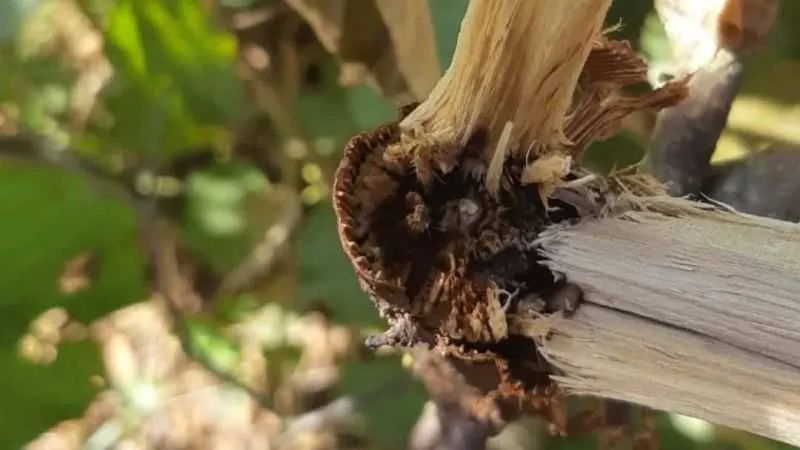
Soil and Leaf Analysis Guide for Hazelnut Orchards
When to have a soil analysis done in a hazelnut orchard, how to take the sample, and how to read the results. Leaf analysis timing and method explained.
Foliar Fertilization in Hazelnuts: When and How to Apply Leaf Fertilizer
What is foliar fertilization in hazelnuts, when and under what conditions is it applied? Concentration logic, leaf burn risk, phenological timing and common mistakes.
Hazelnut Fertilization Program: Annual Schedule and Application Rates
When to fertilize hazelnuts, which fertilizer types to use, and how much per decare. A practical guide to nitrogen, phosphorus, potassium and organic fertilizer applications.
Zinc Sulfate (ZnSO₄) on Hazelnut: Deficiency, Dose and Timing
How do you recognise zinc deficiency in hazelnut, and when and at what rate is zinc sulfate applied to the soil or the leaf? Results from the Ordu Palaz trial and leaf-analysis critical values.
More Fertilization Guides
Ammonium Nitrate (33-0-0): Use, Dosage and Leaching Risk in Hazelnuts
What is ammonium nitrate fertilizer and how is it used in hazelnuts? The 16.5% ammonium + 16.5% nitrate balance, how it differs from CAN, behaviour on acid soils, nitrate leaching and dose calculation.
Ammonium Sulfate (21-0-0) Fertilizer: Use in Hazelnuts and the Acidity Risk
What is ammonium sulfate fertilizer, and when and how should it be used in hazelnut orchards? 21% nitrogen + 24% sulfur, dosage logic, soil acidification risk and a comparison with CAN.
Farmyard Manure and Organic Matter in Hazelnut Orchards: Building the Foundation
What does farmyard (barn) manure do in a hazelnut orchard, what is well-rotted manure, when and how is it applied? The role of organic matter in holding water and nutrients, husk compost and common mistakes.
Zinc Sulfate (ZnSO₄) on Hazelnut: Deficiency, Dose and Timing
How do you recognise zinc deficiency in hazelnut, and when and at what rate is zinc sulfate applied to the soil or the leaf? Results from the Ordu Palaz trial and leaf-analysis critical values.