What Is Ammonium Nitrate (33-0-0)?
Ammonium nitrate (NH₄NO₃) — known in the Turkish market as “33% nitrate” or simply AN 33 — is a white, granular or prilled nitrogen topdressing fertilizer. In fertilizer notation it appears as 33-0-0: it contains no phosphorus and no potassium.
Its name comes from the fact that it carries nitrogen in two different chemical forms. According to Ege Gübre’s product information, half of the 33% nitrogen is ammonium nitrogen (16.5% NH₄-N) and half is nitrate nitrogen (16.5% NO₃-N). It dissolves in water quickly and leaves no residue, so its effect starts fast while the ammonium half keeps feeding the plant for longer than some other nitrogen sources.
| Property | Value |
|---|---|
| Formula | NH₄NO₃ (33-0-0) |
| Total nitrogen (N) | 33% |
| Ammonium nitrogen (NH₄-N) | 16.5% |
| Nitrate nitrogen (NO₃-N) | 16.5% |
| Phosphorus / Potassium | None |
| Filler | None (contains no lime) |
| Solubility | Fast and residue-free in water |
| Physical form | White granules or prills |
| Main weakness | Leaching of the nitrate half |
| Sale and storage | Subject to regulation — see the section below |
How Does It Differ From CAN?
These two fertilizers are constantly confused, because their nitrogen forms are identical: in both, half the nitrogen is ammonium and half is nitrate. The difference lies in what else is put into the product.
Calcium ammonium nitrate (CAN, 26-0-0) has lime (CaCO₃) or dolomitic lime filler added during manufacture. That filler does two jobs: it largely removes the explosive character of ammonium nitrate, and it adds calcium to the product. The price is that nitrogen content drops from 33% to 26%.
Ammonium nitrate has no such filler. AN 33 is, in effect, CAN without the lime and in a more concentrated form.
100 kg of CAN ≈ 79 kg of AN 33
To deliver the same amount of pure nitrogen you need less AN 33: 26 ÷ 33 = 0.79. So roughly 79 kg of ammonium nitrate carries the nitrogen of 100 kg of CAN. On steep orchards far from the road that difference is measured in sacks carried on your back. In exchange you give up the calcium CAN supplies and the buffering effect of its lime.
What Does It Do in a Hazelnut Orchard?
Nitrogen is the nutrient hazelnut consumes most; it directly determines annual shoot length, leaf area and therefore next year’s cluster count. What ammonium nitrate adds here is that it supplies nitrogen at two speeds:
- Nitrate nitrogen (NO₃⁻) — fast acting. Taken up directly by the roots with no conversion step. It works even in the late February–March application while the soil is still cold, because what slows down in cold soil is nitrification, not nitrate uptake.
- Ammonium nitrogen (NH₄⁺) — lasting effect. Being positively charged, it binds to the clay and organic colloids of the soil and does not leach easily. As bacteria convert it to nitrate over the following weeks, feeding is spread out in time.
Unlike urea, which must first be hydrolysed, this dual structure delivers a response in the first days after application. The biggest risk in urea — ammonia volatilization — does not exist in ammonium nitrate, because there is no amide nitrogen to break down.
Ammonium Nitrate on Acid Soils: Three Fertilizers Side by Side
Black Sea hazelnut soils are acidic in character. In samples taken from 71 hazelnut orchards in the Kumru district of Ordu, soil pH ranged from 4.53 to 7.87 📚 Karadeniz & Özkutlu, 2023 The Hazelnut Research Institute states that hazelnut grows normally in the pH 5–7 range, while the Giresun Provincial Directorate reminds growers that nitrogen uptake declines on soils that fall below pH 4.5.
That is why the decisive question in choosing a nitrogen fertilizer is: how much further will this product acidify my soil?
The mechanism is well established: it is the ammonium nitrogen in a fertilizer that acidifies, because soil bacteria release two hydrogen ions (H⁺) for every nitrate ion produced during nitrification. Nitrogen already in nitrate form has no acidifying effect 📚 Mosaic Crop Nutrition
From this, the ranking of the three fertilizers follows by itself:
| Criterion | Ammonium Sulfate (21-0-0) | Ammonium Nitrate (33-0-0) | CAN (26-0-0) |
|---|---|---|---|
| Nitrogen content | 21% | 33% | 26% |
| Share of N as ammonium | 100% | 50% | 50% |
| Additional acid source | Sulfate residue | None | None |
| Lime filler | None | None | Yes (CaCO₃ / dolomite) |
| Degree of acidification | Highest | Moderate | Near neutral |
| Extra nutrient | 24% sulfur | None | Calcium (+ magnesium) |
| Nitrate leaching risk | Low | High | High |
| On acid Black Sea soils | Not advisable | Usable with a liming programme | The option official sources recommend |
Ammonium sulfate sits in a category of its own: if a crop’s entire nitrogen requirement is supplied as ammonium sulfate, 1.5 to 2 times more lime is needed than when the same nitrogen comes from ammonium nitrate or urea 📚 AdvanSix - Ask the Agronomist That is because all of its nitrogen is ammonium and it also leaves a sulfate residue as it dissolves.
In ammonium nitrate only half the nitrogen is ammonium, so the acidifying load is halved. CAN carries the same nitrogen forms, but its lime filler buffers that load and it behaves as practically neutral.
Moderate Does Not Mean Zero
Some product catalogues describe ammonium nitrate as “not changing soil pH”. That is a reasonable simplification for calcareous, well-buffered soils. It does not hold in a hazelnut orchard whose pH has already dropped below 5: the ammonium half will keep deepening the acidity year after year. If you use ammonium nitrate, treat liming as part of your programme.
Nitrate Leaching Under Black Sea Rainfall
The real constraint on ammonium nitrate in hazelnuts is not acidity but nitrate leaching.
The nitrate ion is negatively charged. Soil colloids are negatively charged too, so they cannot hold nitrate; it moves with the soil water. On the eastern Black Sea coast, where annual rainfall exceeds 1,000 mm in most places, that means nitrogen draining below the root zone. The Giresun Provincial Directorate of Agriculture and Forestry ties the need to split nitrogen applications directly to this: because of heavy rainfall, leaching and nitrogen loss from these soils are high.
Technical product information from the fertilizer industry agrees: because its nitrate nitrogen leaches easily, ammonium nitrate should be applied in two or three split doses rather than all at once in high-rainfall regions 📚 Ege Gübre - AN Product Information
✓ How to Reduce Nitrate Loss
- ✓ Never apply the annual dose in one go — split it in two, or three on sandy, very wet sites
- ✓ Apply close to the moment the plant needs it, not months in advance
- ✓ Avoid applying just before heavy rain; slightly moist soil is ideal
- ✓ Work the fertilizer 5–10 cm into the soil — anything left on the surface runs off on a slope
- ✓ On sandy, light-textured soils use smaller, more frequent splits
- ✓ Raise soil organic matter; the greater the holding capacity, the smaller the loss
When Is It Applied in Hazelnuts?
The nitrogen calendar in official sources does not change with the product; what governs it is hazelnut phenology. The Giresun Provincial Directorate’s advisory describes the schedule as follows:
| Application | Timing | Share | Phenological stage |
|---|---|---|---|
| 1st application | Late February – early March (in practice after 15 March) | Half | Bud break; conversion and growth of the flower clusters |
| 2nd application | Late May – early June (in practice after 15–20 May) | Half | Kernel filling and formation of next year’s flower buds |
Depending on altitude and the season, these dates shift by two to three weeks from orchard to orchard. The criterion is the state of the buds, not the calendar.
No Nitrogen After July
Late nitrogen prolongs shoot growth; the tree enters winter before its wood has hardened off and is left exposed to frost damage. Softened leaf tissue also raises the risk of powdery mildew. For the full annual calendar see our Hazelnut Fertilization Programme.
How Is It Applied?
The method described in official sources is common to all nitrogen fertilizers: the product is spread in a 30–40 cm wide band under the drip line of the branches and worked 5–10 cm into the soil.
✓ Ammonium Nitrate Application Steps
- ✓ Locate the drip line of the stool's branches — the fine absorbing roots concentrate there
- ✓ Picture a 30–40 cm wide band along that line
- ✓ Spread the calculated amount evenly in the band; never pile it against the trunk (it burns roots)
- ✓ Work it 5–10 cm deep with a hoe or rake
- ✓ Apply when the soil is in good tilth; dissolution is poor in dry soil and distribution poor in mud
- ✓ On slopes, weight the application to the sides of the stool and give least on the uphill side
- ✓ If you have limed, leave at least one month between liming and nitrogen
Incorporation here is not about preventing volatilization losses as with urea; it is about slowing surface runoff and the rapid downward movement of nitrate. On sloping hazelnut orchards this single step makes the biggest difference.
How Is the Dose Calculated?
Step 1: Get your pure nitrogen requirement from a soil analysis
In TAGEM’s Fertilizer Recommendations, the nitrogen to be applied to hazelnut in the Black Sea Region is set according to the soil’s organic matter content:
| Soil organic matter | Pure nitrogen requirement (kg N/decare) |
|---|---|
| 0 – 1.0% | 20 |
| 1.1 – 2.0% | 18 |
| 2.1 – 3.0% | 16 |
| 3% and above | 14 |
Step 2: Convert pure nitrogen into fertilizer quantity
The same publication gives the conversion factors from pure nitrogen to product weight. For ammonium nitrate the factor is × 3.0 (100 ÷ 33 = 3.03).
| Fertilizer | Nitrogen content | Conversion factor |
|---|---|---|
| Ammonium Nitrate (AN) | 33% | × 3.0 |
| Calcium Ammonium Nitrate (CAN) | 26% | × 4.0 |
| Ammonium Sulfate (AS) | 21% | × 5.0 |
| Urea | 46% | × 2.2 |
Worked example: the analysis shows 2.5% organic matter → recommendation 16 kg pure N per decare → 16 × 3.0 = 48 kg of ammonium nitrate per decare. Half of that goes on in March, half in late May–early June.
The per-stool equivalent
The Giresun Provincial Directorate recommends 650 + 650 g of 26% CAN per stool (1,300 g in total). That works out at roughly 340 g of pure nitrogen per stool per year. Supplying the same nitrogen as ammonium nitrate would require roughly 1,000–1,050 g per stool per year, that is about 500 g per application. This figure is not an official ammonium nitrate recommendation; it is the arithmetic equivalent of the official CAN recommendation.
Per-decare figures differ between sources — the 13–15 kg of ammonium nitrate per decare given for the March application in our fertilization programme guide is the lower end of a single split for orchards with a low nitrogen requirement. Where you sit in that range is decided by analysis, not by guesswork.
These Figures Are a Starting Point
The values above are general recommendations from official publications and calculations derived from them. The exact dose depends on your own soil analysis; organic matter, pH, stool density, tree age and yield level all change the answer. Have a soil analysis done before you apply anything, and have the report interpreted by your provincial or district directorate of agriculture and forestry or by an agricultural engineer.
Sale, Storage and Safety
Besides being a fertilizer, ammonium nitrate is a chemical that can be misused in the manufacture of explosives. For that reason its production, sale, transport and storage in Türkiye are governed by specific regulation, and the rules change from period to period. For the background to the long ban on 33% ammonium nitrate in Türkiye and its temporary release in 2026, see our news article on the lifting of the 33% nitrate ban.
This article is not a legal source. Purchase conditions, registration and entitlement systems and prescription requirements all vary — prescription rules for nitrate fertilizers can also cover products such as CAN; indeed the Giresun Provincial Directorate’s advisory states that growers must obtain an e-prescription from their provincial or district directorate for 26% CAN. For the current rules, always consult your provincial or district directorate of agriculture and forestry.
Basic storage practices to follow:
- Keep it dry and cool. Ammonium nitrate absorbs moisture and cakes quickly; do not keep it in store for long, buy for the season.
- Keep it away from heat sources and direct sunlight.
- Separate it from flammable and organic materials. Do not store it in the same compartment as fuel, oil, straw, wood shavings or organic material other than the fertilizer sacks themselves.
- Keep it in a locked, controlled area and do not stockpile more than you need.
- Keep packaging closed and stack it on pallets so it does not touch the floor.
Common Mistakes
- Treating AN 33 and CAN 26 as interchangeable at the same rate. They carry the same nitrogen forms but different concentrations; applying the CAN rate as ammonium nitrate delivers about 27% more nitrogen than intended.
- Applying the whole annual dose at once. Under Black Sea rainfall a large share of the nitrate drains below the root zone.
- Assuming “a nitrate fertilizer does not acidify soil”. The ammonium half does acidify; in a low-pH orchard liming cannot be skipped.
- Counting ammonium nitrate as liming. Unlike CAN, it does not even contain a lime filler.
- Dumping it against the trunk. The absorbing roots are under the canopy edge; the base of the trunk is both ineffective and risky.
- Leaving it on the surface. On sloping ground the first downpour carries it out of the orchard.
- Liming and fertilizing in the same period. This increases nitrogen loss; leave at least a month between them.
- Applying nitrogen after July. It delays hardening off and raises frost and mildew risk.
- Forgetting phosphorus and potassium. AN 33 supplies nitrogen only; phosphorus and potassium must be planned separately.
Summary: Ammonium Nitrate Checklist
- Content: 33% nitrogen — 16.5% ammonium + 16.5% nitrate. No lime filler.
- Difference from CAN: same nitrogen forms, more concentrated, no lime. 100 kg CAN ≈ 79 kg AN 33.
- Acidification ranking: ammonium sulfate > ammonium nitrate > CAN. AN 33 acidifies moderately.
- Its real risk: nitrate leaching. The answer is split application and correct timing.
- Timing: half in late February–March, half in late May–early June. Never after July.
- Application: spread in the 30–40 cm band under the drip line and work it 5–10 cm deep.
- Dose: multiply the pure nitrogen recommendation from your analysis by 3.0; confirm the final figure with your directorate of agriculture.
- Safety: sale and storage are regulated; store dry, cool, locked and away from flammable materials.
To compare nitrogen sources, read our guides on Calcium Ammonium Nitrate (26-0-0), Ammonium Sulfate (21-0-0) and Urea (46-0-0); for sampling and reading the report see our Soil Analysis Guide.
📚 Hazelnut Research Institute - Hazelnut Growing Technique 📚 Giresun Provincial Directorate of Agriculture and Forestry - Summer Nitrogen Fertilization of Hazelnuts 📚 TAGEM - Fertilizer Recommendations 📚 Ege Gübre - AN (Ammonium Nitrate) 📚 AdvanSix - Ask the Agronomist 📚 Mosaic Crop Nutrition - Fertilizers and Soil Acidity 📚 Karadeniz & Özkutlu, 2023 - Academic Journal of Agriculture📚Sources
- Republic of Türkiye Ministry of Agriculture and Forestry - Hazelnut Research Institute, Hazelnut Growing Technique
- Giresun Provincial Directorate of Agriculture and Forestry - Points to Consider in Summer Nitrogen Fertilization of Hazelnuts
- TAGEM - Fertilizer Recommendations (Soil-Water Fertilizer Advisory Data)
- Ege Gübre - AN (Ammonium Nitrate) Product Information
- AdvanSix - Ask the Agronomist: Soil Acidification and Liming Needs of Nitrogen Sources Compared
- Mosaic Crop Nutrition - Fertilizers and Soil Acidity
- Karadeniz, U. & Özkutlu, F. (2023) - Soil Fertility Status of Hazelnut Orchards in the Ordu-Kumru Area, Academic Journal of Agriculture
Related Guides
View all Fertilization guides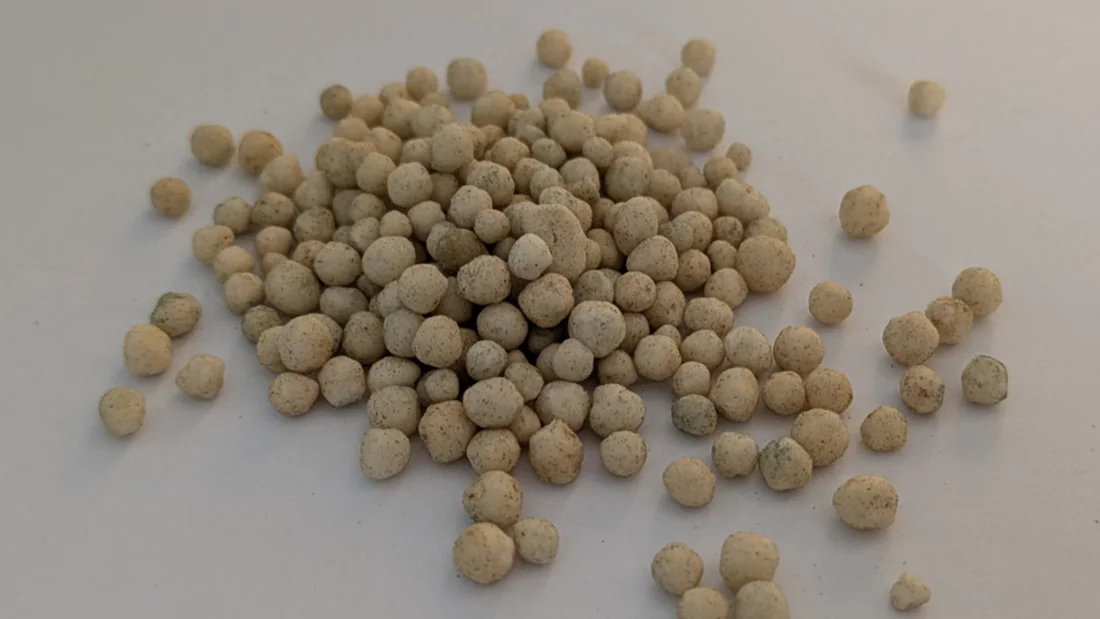
Calcium Ammonium Nitrate (CAN, 26-0-0): Use and Dosage in Hazelnuts
What is CAN fertilizer and why is it preferred for hazelnuts? 26% nitrogen, the ammonium-nitrate balance, safe use on acid soils, timing and dose calculation.
Ammonium Sulfate (21-0-0) Fertilizer: Use in Hazelnuts and the Acidity Risk
What is ammonium sulfate fertilizer, and when and how should it be used in hazelnut orchards? 21% nitrogen + 24% sulfur, dosage logic, soil acidification risk and a comparison with CAN.
Urea (46-0-0) Fertilizer: When, How and How Much to Use on Hazelnuts
Urea contains 46% nitrogen and is the cheapest source of nitrogen per unit. Timing, dosage, soil incorporation and how to stop losing nitrogen to ammonia volatilization in hazelnut orchards.
Hazelnut Fertilization Program: Annual Schedule and Application Rates
When to fertilize hazelnuts, which fertilizer types to use, and how much per decare. A practical guide to nitrogen, phosphorus, potassium and organic fertilizer applications.
More Fertilization Guides
Ammonium Sulfate (21-0-0) Fertilizer: Use in Hazelnuts and the Acidity Risk
What is ammonium sulfate fertilizer, and when and how should it be used in hazelnut orchards? 21% nitrogen + 24% sulfur, dosage logic, soil acidification risk and a comparison with CAN.
Boron Fertilization in Hazelnuts: Blank Nuts, Dosage and Toxicity Risk
What does boron do in hazelnuts, and does a deficiency cause blank nuts? Critical boron values in soil and leaf analysis, soil and foliar application rates, and the risk of boron toxicity.
Farmyard Manure and Organic Matter in Hazelnut Orchards: Building the Foundation
What does farmyard (barn) manure do in a hazelnut orchard, what is well-rotted manure, when and how is it applied? The role of organic matter in holding water and nutrients, husk compost and common mistakes.
Zinc Sulfate (ZnSO₄) on Hazelnut: Deficiency, Dose and Timing
How do you recognise zinc deficiency in hazelnut, and when and at what rate is zinc sulfate applied to the soil or the leaf? Results from the Ordu Palaz trial and leaf-analysis critical values.