Hazelnut Care Calendar
Month-by-month hazelnut orchard care calendar: tasks for every month of the year.
3 guidesA hazelnut orchard runs on a repeating annual cycle in which several jobs have windows measured in days rather than weeks. Pruning has to finish before the sap rises; the shoot moth spray is useless once the buds have burst; the first protective copper application belongs before the autumn rains, not after them. A care calendar exists to stop those windows from being missed while you are busy with something else.
The month-by-month guides currently available in English are January, February and March - the three months that carry winter pruning, dormant-season pest work, farmyard manure, the pollination period and the first nitrogen application. The remaining months are published in the Turkish edition of this site, and the summary table below sets out the full year so you can see how the pieces fit together.
Treat any published calendar, including this one, as a starting template. The correct dates for your orchard depend on altitude, distance from the coast, aspect and variety, and they can differ from a neighbouring valley by two or three weeks. The last section explains how to convert the generic version into your own.

March Hazelnut Care Guide
First nitrogen fertilization, final pruning, shoot moth and gall midge monitoring, sapling planting in the hazelnut orchard in March. Guide supported by official sources.
February Hazelnut Care Guide
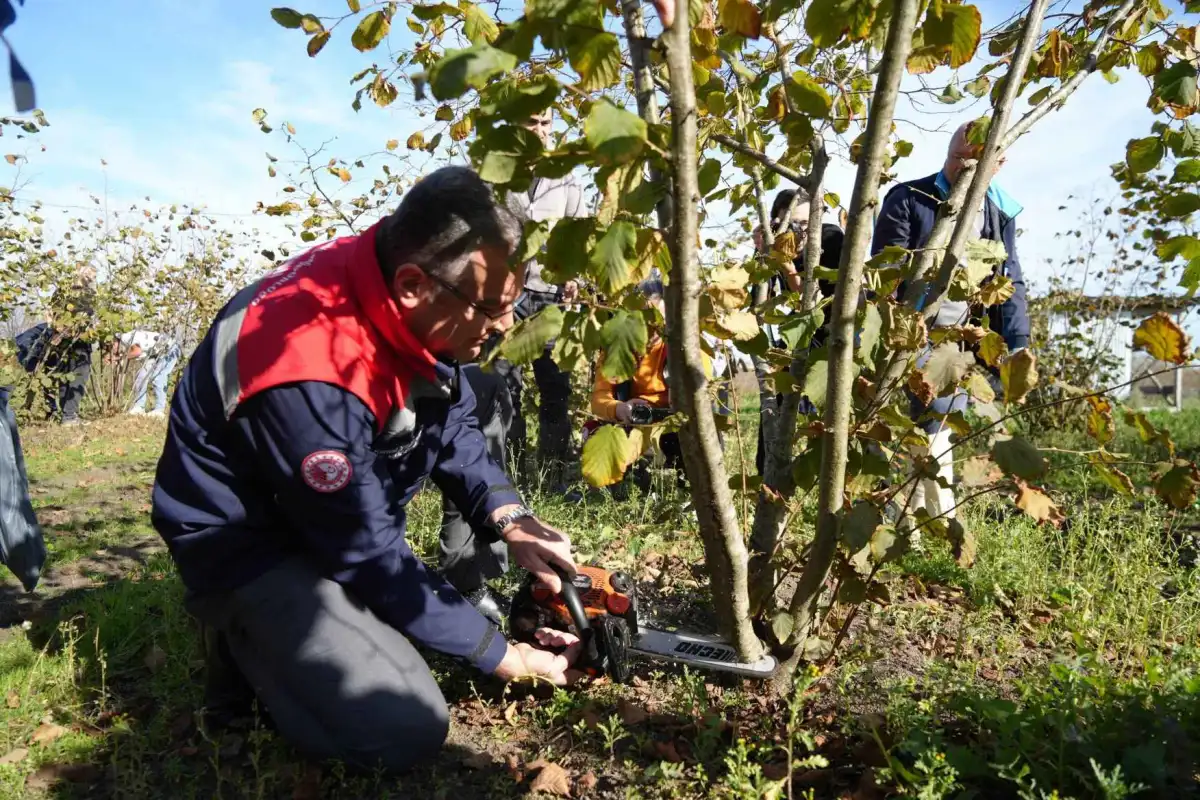
Pruning, fertilization, pest spraying and pollination monitoring in the hazelnut garden in February. Guide supported by official sources.
January Hazelnut Care Guide
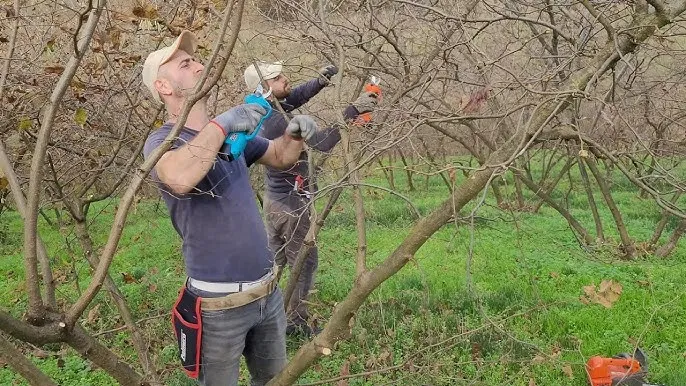
Winter pruning, sucker removal, dormant-season spraying, soil sampling, snow damage checks and infrastructure repair in the hazelnut orchard in January. Guide supported by official sources.
The Logic of the Hazelnut Year
The dormant season, from leaf fall to bud swell, is when structural work happens. The bush is asleep, the framework is visible, there is no crop to damage and machinery does not harm new growth, so pruning, sucker removal, dormant-season spraying, soil sampling, drainage and track repair and equipment servicing all belong here. It is the only stretch of the year with slack in it, and work postponed out of it tends to be work that never gets done.
Spring is a sequence of narrow windows that open in a fixed order: bud swell, then flowering and pollination, then bud burst and shoot growth. The first half of the nitrogen goes on as buds swell in mid-March; the pruning window closes as they burst; the bud mite, shoot moth and gall midge treatments each have their own moment in the same few weeks. Miss the order and you cannot recover it, because the plant does not wait.
Summer is about water, monitoring and the crop. June and July are the critical irrigation period and the kernel-filling phase, which is also when potassium support and leaf sampling belong; nitrogen stops after July so the bush can harden off for winter. Harvest runs from mid-August, followed immediately by threshing and drying. Autumn then reopens the cycle: the post-harvest copper spray before the rains, soil analysis in September-October, liming in November if the pH calls for it, and pruning beginning again from November.
Phenology: Follow the Bush, Not the Date
In full dormancy hazelnut is remarkably tough, tolerating temperatures down to around -25°C. That resilience disappears as soon as the plant starts to move. The frost protection guide gives the thresholds that matter: male catkins are killed completely at -8°C and female flowers at -16°C, and once shoot and fruit development is under way damage begins below 0°C. Which is why a mild February is not automatically good news - early bud break simply moves the vulnerable stage into the part of the year when frosts still happen.
Flowering comes early and is easy to miss. In February the male catkins hang down and shed pollen into the wind while the reddish stigmas of the female flowers become visible on the buds. Hazelnut is wind-pollinated, so there is no insect activity to alert you and nothing to do except confirm that pollen is being released and that the orchard contains adequate pollinator varieties - inadequate pollination shows up much later as an increased proportion of empty nuts.
After bud burst the sequence runs through shoot growth and fruit set in spring, kernel filling through June and July, and ripening from August. Ripening is judged by the husks: browning, tips curling open, nuts loosening and the first natural drop. Every one of those stages is a better trigger for action than a date, and every one of them shifts a little from season to season.
Altitude, Coast and Inland: Why Two Neighbours Can Be Three Weeks Apart
Harvest dates make the geography obvious. Coastal Ordu starts earliest, around 5-10 August; coastal Giresun around 10-15 August; Trabzon from 10-15 August with harvest continuing into early September; Düzce and Sakarya from 15-20 August into early September; and high inland orchards from 20-25 August through to mid-September. Altitude, climate and variety together account for a shift of one to three weeks in either direction, and the same shift applies to every other job in the calendar, not just harvest.
Altitude changes risk as well as timing. Higher orchards have a narrower pruning window between hard frosts, later bud break, and markedly more branch canker, since the cool, humid conditions that favour the fungus are more common with elevation - the branch canker guide advises against planting susceptible cultivars such as Fosa and Mincane above about 300 m and recommends cold-hardy alternatives instead. Late spring frosts and hail also cause more wounding at altitude, which feeds back into disease pressure the following season.
Within a single orchard the microclimate matters too. Cold air is heavy and pools in hollows, creating frost pockets, while sloping ground with good air drainage escapes the worst of it and south-facing slopes warm earlier. If part of your orchard consistently runs a week behind the rest, or is consistently the part that gets frosted, that is the geography talking - and it is worth building into your working calendar rather than fighting.
Turning a Generic Calendar Into Your Own
Keep records. Write down the date buds began to swell, when the catkins shed pollen, when the first symptoms of anything appeared, when you sprayed and what the result was, and the date harvest started. After two or three seasons you will have your own calendar, offset from the published one by a known number of days, and that offset is worth more than any general guide because it is measured in your orchard rather than in an average one.
Add instrumentation where it is cheap. A minimum-maximum thermometer in the orchard tells you what the overnight low actually was rather than what the regional forecast said, and following frost bulletins from the provincial and district agricultural directorates gives you warning to act. Clear nights with low humidity and still air are the classic frost signature. The frost protection guide covers what to do once the warning arrives.
Finally, confirm anything that is legally or biologically tight with someone local. Region-specific dates for dormant-season spraying and for the shoot moth window, and the list of currently licensed products, both come from your provincial or district agricultural directorate. Use the calendar to know what is coming and to have the equipment and materials ready in advance; use the bushes, the weather and local advice to decide the exact day. The care and pruning, fertilization, disease and pest guides fill in the detail behind each entry.
The hazelnut year at a glance
| Month | Main jobs |
|---|---|
| January | Winter pruning, sucker removal, soil sampling, snow damage checks, drainage and track repair, tool servicing - full guide |
| February | Pruning continues, dormant spray for comma scale, hand-picking bud mite buds, farmyard manure, pollination monitoring - full guide |
| March | First half of the nitrogen, final pruning before bud burst, shoot moth spray, gall midge and leaf roller monitoring, last sapling planting - full guide |
| April | Powdery mildew programme begins, husk formation, watch for late frosts |
| May | Second half of the nitrogen at the end of the month, hazelnut weevil adults emerge from the soil, foliar micronutrients |
| June | Critical irrigation period, kernel filling begins, potassium support, weevil follow-up if needed |
| July | Irrigation, leaf sampling, stink bug monitoring; no nitrogen after this month |
| August | Harvest from mid-month, threshing within 24-48 hours, drying; first protective copper spray at the end of the month |
| September | Late harvest completed, soil analysis, shallow cultivation to expose weevil pupae |
| October | Soil analysis results and fertilizer planning, phosphorus and potassium, pruning may begin |
| November | Copper spray at about 75% leaf fall, liming if pH is low, winter fertilization, pruning season opens |
| December | Pruning and sucker removal, removal of prunings, infrastructure and equipment work |
Frequently Asked Questions
Can I follow this calendar exactly wherever my orchard is?
Not exactly. Harvest alone shifts by one to three weeks between the coastal belt and high inland orchards, and every job before it shifts with it. Use the calendar for the order of operations and to prepare in advance, then set the actual dates from what your own bushes are doing and from advice from your local agricultural directorate.
Which month is best for pruning hazelnut?
January is the peak month: the bush is fully dormant, reserves have moved down into the roots and trunk, and the framework is clearly visible. The season runs from late November through February, with the first ten to fifteen days of March as a last opportunity. Within January, pick dry days above 0°C and wait out hard frosts, snow and rain.
When does the first nitrogen fertilizer go on?
Around mid-March, when the soil has thawed and the buds start to swell, with the second half applied in late May. The February guide notes that the first portion can go on at the end of February if the soil is not frozen and no heavy rain is expected. Set the amount from a soil analysis rather than from habit, and work the fertilizer into the soil under the canopy drip line.
Why does the calendar say to stop applying nitrogen after July?
Late nitrogen keeps the bush pushing new shoots when it should be hardening off. Growth that is still soft going into autumn is more vulnerable to early frosts and to infection, and the plant enters winter less prepared. Potassium works in the opposite direction, raising cell sap concentration and improving cold tolerance, which is why it is the nutrient of the late season rather than nitrogen.
What actually happens in the orchard in February - is anything flowering?
Yes. Hazelnut flowers in the depth of winter: the male catkins lengthen and release pollen into the wind, and the small red stigmas of the female flowers appear on the buds. It is wind pollination, so there is nothing to manage on the day, but it is worth walking the orchard to confirm pollen is being shed, since poor pollination shows up as empty nuts at harvest.
I missed a job in its window. Is it worth doing late?
It depends on why the window exists. A missed dormant spray can shift from January into February, since the window is defined by leaf fall and bud swell rather than by the date. A shoot moth application after the buds have burst, or pruning after mid-March, is a different matter - those windows are biological and close completely. When in doubt, ask your agricultural directorate before spending money on a late application.
Download Findik App
Download the Findik app for job listings, team building and more.