
What Is the New Powdery Mildew?
Erysiphe corylacearum is an invasive fungal species that causes a new type of powdery mildew disease in hazelnuts. Of Asian origin, this pathogen was originally known only on wild hazelnut species such as Asian hazel (Corylus heterophylla), Japanese hazel (C. sieboldiana) and American beaked hazel (C. cornuta). However, in the early 2010s, it jumped to cultivated hazelnut (Corylus avellana), triggering a global epidemic that threatens world hazelnut production.
The traditional powdery mildew agent Phyllactinia guttata had been a known and relatively harmless disease in hazelnut orchards for decades. The new powdery mildew, however, is an entirely different pathogen — far more aggressive and economically devastating.
Why Is It So Dangerous?
Erysiphe corylacearum is far more dangerous than the traditional powdery mildew Phyllactinia guttata. It infects leaves, shoots and husks simultaneously, forms dense mycelial layers on both leaf surfaces, and if left untreated causes 20-40% yield loss. The vast majority of current hazelnut cultivars are susceptible to this pathogen.
Arrival in Turkey and Spread
First Detection (2013)
In the spring of 2013, previously unseen powdery mildew symptoms were noticed on hazelnut leaves, husks and shoots in the provinces of Giresun, Ordu and Trabzon. Subsequent examinations determined the agent to be the Asian-origin Erysiphe corylacearum, and this was announced to the scientific community as the first global report of the pathogen on cultivated hazelnut (Sezer & Dolar, 2017).
Rate of Spread
The disease spread at an incredible rate after its first detection:
| Year | Country/Region | Source |
|---|---|---|
| 2013 | Turkey (Giresun, Ordu, Trabzon) | Sezer & Dolar, 2017 |
| 2014-2016 | Spread to all Eastern and Western Black Sea regions | Ministry of Agriculture reports |
| 2017 | Official record in Turkey through scientific publication | Phytoparasitica |
| 2018 | Azerbaijan, Iran | Abasova et al.; Arzanlou et al. |
| 2018-2019 | Georgia | Meparishvili et al. |
| 2019 | Ukraine | Heluta et al. |
| 2020 | Italy, Switzerland, Austria | Multiple reports |
| 2021 | Germany, Hungary, Spain, Slovenia | EPPO reports |
| 2023 | Bulgaria, Czech Republic | Plant Disease |
Significance for Turkey
Turkey is the world’s largest hazelnut producer, and the vast majority of production comes from the Black Sea coast. Since the disease first appeared in 2013, it has created a severe epidemic across all hazelnut production areas, causing economic damage. Particularly in Ordu, Giresun and Trabzon, noticeable declines in yield per unit area have been experienced.
Differences from Traditional Powdery Mildew
There are important differences between Erysiphe corylacearum and the old type powdery mildew Phyllactinia guttata. Knowing these differences is critical for correct diagnosis and effective management:
| Feature | Traditional Powdery Mildew (P. guttata) | New Powdery Mildew (E. corylacearum) |
|---|---|---|
| Origin | Native to Europe and Asia | Invasive from East Asia |
| Infection site | Generally lower leaf surface | Leaf both surfaces, shoots, husks |
| Symptom onset | Mid-summer - autumn (late season) | Spring - early season (April-May) |
| Severity | Mild-moderate | High - very high |
| Mycelium appearance | Thin, sparse powder | Thick, dense white coating |
| Conidium shape | Single-celled, rod/rhomboid | Single-celled, oval/ellipsoid/barrel-shaped |
| Chasmothecia | Round-flattened, with 3-15 appendages | Round, with dichotomously branched appendages |
| Yield impact | 10-20%, limited | 20-40+%, serious economic loss |
| Control required? | Generally little/none required | Absolutely necessary |
How to Distinguish Them?
The most obvious difference: P. guttata appears only on the lower leaf surface and in late season, while E. corylacearum starts in spring and forms dense white spots on the upper leaf surface. Additionally, the new powdery mildew also infects shoots and husks; the old powdery mildew rarely does this.
Symptoms
Leaf Symptoms
Erysiphe corylacearum symptoms begin early in the growing season in spring:
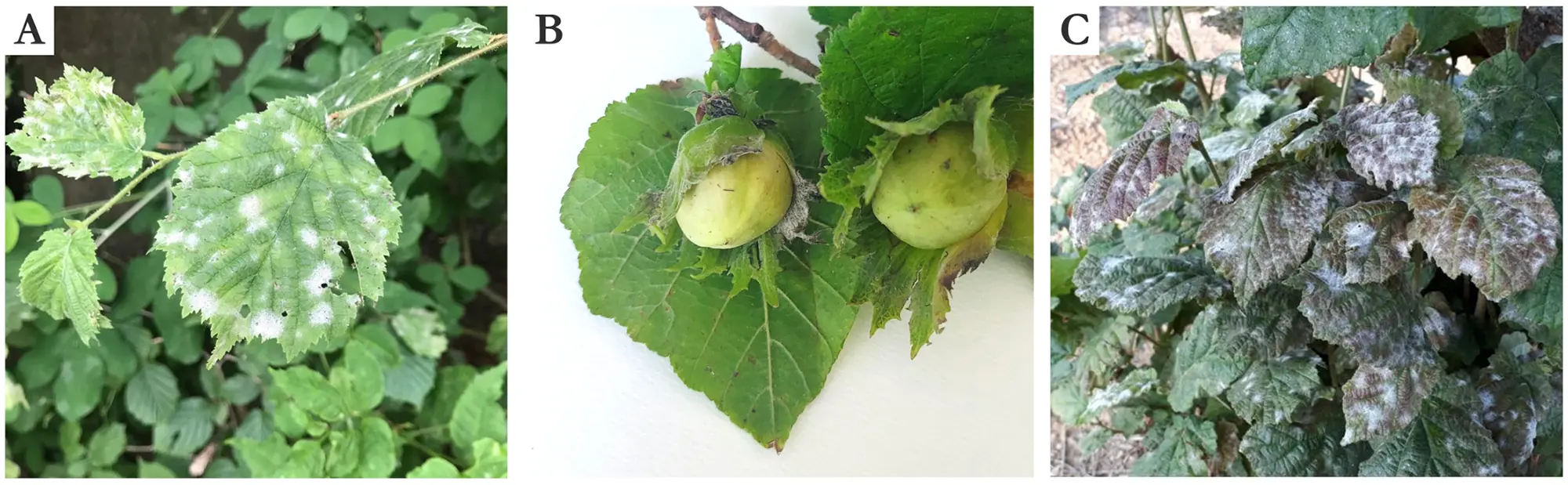
- Early stage: Round, white powdery spots 0.5-1.5 cm in diameter appear on the upper leaf surface. Pale-chlorotic areas are visible around the spots
- Leaf lower surface: Spots changing from yellow to brown appear directly below the white spots on the upper surface
- Progression: White powdery spots enlarge and merge; the leaf surface can become completely covered with a white coating as if dusted with flour
- Late stage: Infected leaves turn purple-bronze, become dull and dry out
- Chasmothecia: At the end of the season, brown-black spherical structures (winter spore structures) visible to the naked eye form on the spots
- Defoliation: In severe infections, leaves dry and drop prematurely
Shoot Symptoms
On young shoots:
- Flour-dusted appearance on the shoot surface
- Dulling and browning as the disease progresses
- Shoot dieback in early-stage infections
Husk and Fruit Symptoms
- White fungal coating on husk surfaces
- Husks darken and become dull
- Fruit development slows or stops
- In early-stage infections, nuts remain small or are completely empty
- Premature fruit drop occurs in severe infections
Early Diagnosis Is Critical
From the second half of April onward, regularly inspect your leaves. The first white spots may be very small but spread rapidly. Early diagnosis is the foundation of successful management. The disease starts as white dots on the upper leaf surface — this is a symptom not seen in traditional powdery mildew.
Yield Loss and Economic Impact
The economic impact of Erysiphe corylacearum powdery mildew disease is far more severe than that of traditional Phyllactinia powdery mildew:
Yield Losses:
- 20-40% direct yield loss reported in untreated orchards
- Losses can be even higher in severe epidemic years
- Premature leaf drop also negatively affects the following year’s yield
Impact on Quality:
- Nut kernels remain small and weak
- Blank nut (empty shell) rate increases
- Internal kernel defect rate increases in long-term storage
- The proportion of product not meeting export quality standards rises
Economic Dimension:
- Turkey produces approximately 600,000-800,000 tons of hazelnuts annually, accounting for 65-70% of world production
- Powdery mildew disease control costs (spraying, labor) have increased noticeably per orchard
- Since the first epidemic in 2013, the disease has caused noticeable declines in yield per unit area, especially in the Eastern Black Sea region
Control Methods
Cultural Measures
Cultural measures must be applied to enhance the effectiveness of chemical control:
- Collection of infected leaves: In autumn, fallen leaves and diseased plant debris should be collected and removed from the orchard or burned. These are the source of winter spores (chasmothecia)
- Sucker cleaning: Infected suckers should be cut and destroyed
- Pruning: Ensure good air circulation and adequate light penetration through regular pruning. A crowded canopy structure increases disease severity
- Weed control: Control weeds to reduce humidity and improve air circulation in the orchard
- Balanced fertilization: Excessive nitrogen fertilization creates soft leaf tissue that increases powdery mildew susceptibility
The Pruning Difference
Powdery mildew severity is noticeably lower in orchards with regular pruning and good ventilation. Before spraying, always clean suckers and perform canopy pruning. Pruning is the first and most important step in powdery mildew management.
Chemical Control Program
Scientific research conducted in hazelnut production areas of Giresun province (2015-2016) revealed the effectiveness of different spray programs. Six different plant protection products were tested in the research:
| Active Ingredient | Mode of Action Group | Effect Type | Leaf Efficacy | Husk Efficacy |
|---|---|---|---|---|
| Sulfur SC 800 g/l | Inorganic | Preventative | 85-96% | 89-97% |
| Fluopyram + Tebuconazole | SDHI + Triazole | Systemic | Variable | Variable |
| Azoxystrobin + Difenoconazole | Strobilurin + Triazole | Preventative + Curative | Good | Good |
| Triadimenol 50% | Triazole | Curative | Effective | Effective |
| Myclobutanil 245 g/l | Triazole | Curative | Effective | Effective |
| Thiophanate methyl 70% | Benzimidazole | Systemic | Moderate | Moderate |
Research Results
In the Giresun research, sulfur showed the highest efficacy in both leaf and husk evaluations across all programs (85-97%). Sulfur is recommended as the first choice because it is economical, environmentally friendly and has a low resistance risk. The other fungicides were also found to be generally effective and can be used in rotation programs.
Spray Timing
Correct timing is the most critical factor determining the success of powdery mildew management:
1st Spray — Husk formation period (mid-April):
- Must be applied as a preventative in orchards where the disease was observed the previous year
- Sulfur-based products are ideal for the first application
- Preventative application should be made even if no symptoms are visible
2nd Spray — 15-20 days later (early May):
- If the disease continues, repeat application with a different active ingredient group
- Triazole group (Tebuconazole, Myclobutanil) can be preferred for curative effect
3rd Spray — If necessary (late May - June):
- Third application if heavy infection is present
- Strobilurin + Triazole combination (Azoxystrobin + Difenoconazole) can be used
4th Spray — If necessary (mid-June - July):
- A fourth application may be needed in severe epidemic years
- Practice resistance management by using a different active ingredient group each time
For the detailed annual spray calendar, see our spray schedule.
Do Not Be Late with Timing
The most common mistake in new powdery mildew management is being late. Once symptoms are visible, the disease has already spread throughout the orchard. In orchards where powdery mildew was observed the previous year, preventative spraying at the husk formation period (mid-April) must absolutely be performed. Bringing the disease under control after it has spread is much more difficult and costly.
Conclusion
Erysiphe corylacearum powdery mildew disease has been the most important new threat to Turkish hazelnut farming since 2013. This invasive fungus of Asian origin rapidly spread to all hazelnut production areas in a short time and has advanced worldwide. Far more aggressive than traditional Phyllactinia powdery mildew, this pathogen causes serious yield and quality losses if not addressed in a timely and correct manner.
For effective management:
- Regularly inspect leaves from April onward
- Perform preventative spraying at the husk formation period in orchards where the disease was observed the previous year
- Sulfur can be used as the first choice; practice rotation with triazole and strobilurin groups
- Do not neglect cultural measures (pruning, leaf collection, sucker cleaning)
- Follow the current control recommendations from your provincial agricultural directorate
For general powdery mildew information, see our Powdery mildew guide. For the annual spray program, see our spray schedule. For all aspects of hazelnut care, review our hazelnut guide.
📚 Sezer & Dolar (2017) - First Turkey Report 📚 Giresun Chemical Control Research 📚 PLOS ONE - Italy Research (2024) 📚 EPPO Reporting Service (2021) 📚 Hazelnut Research Institute📚Sources
Related Guides
View all Diseases guides
Powdery Mildew in Hazelnuts: Symptoms, Control and Spraying
What is powdery mildew in hazelnuts, what are its symptoms, when should you spray and how is it controlled? Includes an overview of the new powdery mildew (Erysiphe corylacearum).
Hazelnut Spraying Calendar: Annual Program for All Pests
Hazelnut orchard spraying calendar: spray timings, dosages and rules against all pests and diseases from February to October.
Hazelnut Growing Guide: From Planting to Harvest, Step by Step
A complete guide to growing hazelnuts. Pruning, fertilization, pest control, harvest and market knowledge — everything a hazelnut grower needs on a single page.
More Diseases Guides
Hazelnut Bacterial Blight: Symptoms, Treatment and Prevention
What is hazelnut bacterial blight (Xanthomonas arboricola pv. corylina), its symptoms, spread pathways and control methods.
Hazelnut Branch Canker: Symptoms, Control and Pruning Methods
What is hazelnut branch canker (Nectria galligena), its symptoms, risk factors at high altitudes and control methods.
Hazelnut Mosaic Disease: Symptoms, Spread and Prevention Methods
What is hazelnut mosaic disease (Apple Mosaic Virus), its leaf symptoms, spread pathways and prevention methods.
Hazelnut Root Rot: Armillaria and Rosellinia Control Guide
Hazelnut root rot diseases (Armillaria mellea, Rosellinia necatrix) symptoms, identification and control methods.