
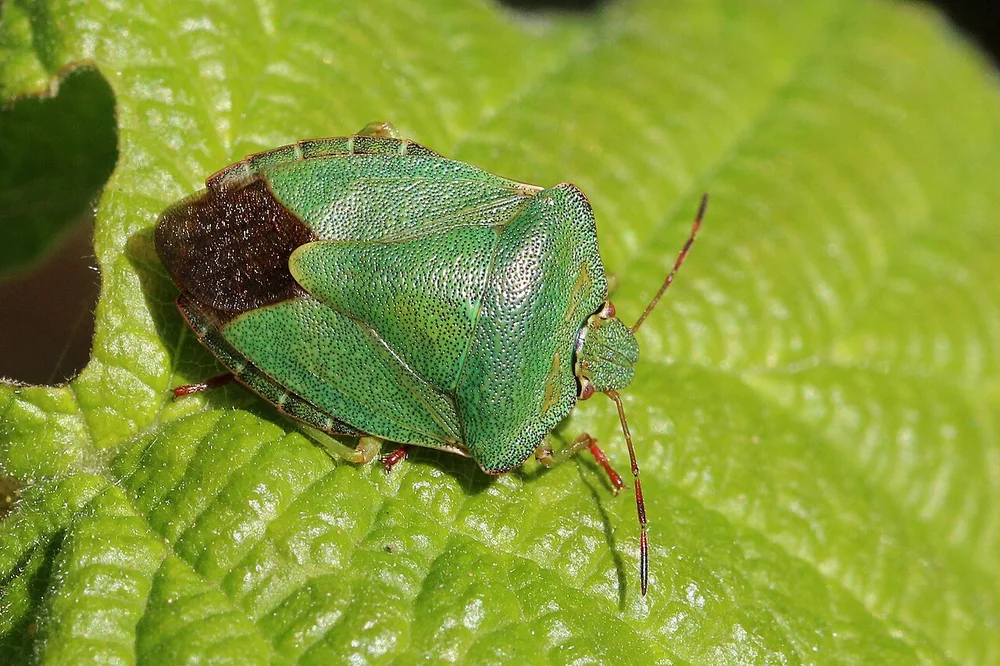
What Is the Green Stink Bug?
The green stink bug (Palomena prasina) is a shield-shaped insect of the family Pentatomidae, 11-14 mm long. It is recognized by its greenish-brown body and the red tips of its antennae and legs. The sharp smell it releases when disturbed is what gives the whole group its common name.
The stink bug does not eat the leaves or bore into the wood. What it does is suck: it inserts its stylet into the developing nut and feeds on the contents. From the outside the damage is usually invisible — the real harm only shows when the nut is cracked open. This is why growers most often discover the damage after harvest, on the drying floor.
The Most Widespread Stink Bug in Turkish Hazelnut
In population counts carried out around Sakarya, Palomena prasina stood out as the species with the highest damage rate among stink bugs, and it exceeded the economic threshold in every hazelnut orchard surveyed. In the Black Sea region, the answer to “do I have it?” is very likely yes.
Damage Symptoms: Blank, Blackened and Spotted Kernels
The damage depends on when the feeding happened. Three distinct outcomes appear, and Turkish growers have a separate name for each:
| Feeding period | Result | Local name |
|---|---|---|
| While the nut is still developing (early) | The kernel never fills; the nut stays blank | sarıkaramuk |
| Somewhat later | The kernel blackens, shrivels and is unusable | karakaramuk |
| After the kernel has filled (late) | Brown to black sunken spots on the kernel | lekeli iç (spotted kernel) |
The spotted kernel is the most treacherous of the three: the nut looks perfectly normal from the outside and only reveals itself when cracked. In kernel trading, this type of damage translates directly into a price deduction.
How to Confirm the Damage
Take a handful of nuts at random from the bushes you suspect and crack them open. Blank kernels, blackened kernels or sunken dark spots all point to stink bug feeding. Do not look for an entry hole on the shell — the stylet puncture is not visible to the naked eye.
Life Cycle
| Stage | Month | What happens |
|---|---|---|
| Overwintering | November – March | Adults overwinter under fallen leaves, in the orchard floor cover and in weeds |
| Emergence | Late March – early April | Overwintered adults appear and begin feeding |
| Egg laying | April – May | The female lays eggs in clusters on the underside of the leaf |
| Nymphs | May – August | Nymphs develop; adults and nymphs both feed on the nuts |
| New adults | August – October | The new generation moves into overwintering sites |
In a population study conducted in Sakarya, adults and nymphs were recorded between 30 April and 24 September. The pest is therefore present in the orchard through almost the entire season; what matters is at which point you intervene.
Economic Threshold
The Ministry’s criterion is a single sentence and easy to apply:
If a count made in mid-April finds 1 overwintered adult across 10 bushes, chemical control is warranted.
The threshold may look low, but the logic is this: a single overwintered female is the source of an entire nymph population that will damage nuts all season. The aim is to catch her before she lays her eggs.
Control Methods
1. Cultural Measures
Cultural control carries more weight here than with most other pests, because the overwintering site is inside the orchard itself:
- Orchard sanitation: adults overwinter in the fallen leaf layer. Collecting leaves and plant debris after harvest directly reduces the overwintering population
- Weed management: research has shown that different weed control methods change both stink bug populations and damage rates. A neglected orchard floor feeds this pest
- Orchard margins: the strip of scrub and weeds at the orchard boundary serves as both an overwintering site and a host area; it should not be left unmanaged
2. Chemical Control
Here lies the most practical feature of this pest: it emerges in the same period as the hazelnut weevil.
- Timing: from mid-April, once the threshold is exceeded — before the overwintered adults lay their eggs
- Combination: because the emergence periods overlap with the hazelnut weevil (Curculio nucum), the Ministry recommends selecting a product effective against both pests. In practice that saves one whole pass through the orchard
- Coverage: since feeding happens on the nut, the spray must reach the nut clusters
Always Consult Before Choosing a Product or Dose
No trade name or dosage is given on this page, deliberately. Registered preparations and their dosages vary by region, pest and year. Do not apply any pesticide without consulting your provincial/district directorate of agriculture and forestry or an agricultural engineer. Always notify local beekeepers before spraying.
3. Biological Control
The Ministry states that in stink bug management it gives priority to biological control, using chemical control only where population density exceeds the economic threshold. The egg parasitoid samurai wasp (Trissolcus japonicus) has been included in release programmes on that basis. This is not a method an individual grower applies alone; it is run regionally.
Green Stink Bug or Brown Marmorated Stink Bug?
Along the Black Sea coast the word kokarca covers two separate species, and their programmes differ:
| Green stink bug (this page) | Brown marmorated stink bug | |
|---|---|---|
| Latin name | Palomena prasina | Halyomorpha halys |
| Status | Native, long established | Invasive, spread in recent years |
| Appearance | Greenish-brown, red tips on antennae and legs | Brown, white bands on the antennae |
| Spraying | Mid-April (if threshold exceeded), together with the weevil | 3 applications through the end of June |
| Extra window | — | September, after harvest, together with the shoot moth |
The Brown Stink Bug Needs a Heavier Programme
If the brown marmorated stink bug is present in your orchard, a single April spray is not enough. The Giresun Provincial Directorate has announced that control should start before egg laying, as soon as the pest is seen, with 3 applications through the end of June. If you cannot tell the two species apart, take a specimen to your provincial directorate — the difference in programme costs a season’s crop.
Frequently Asked Questions
When should the spray be applied? For the green stink bug (Palomena prasina), from mid-April, once the threshold is exceeded. The threshold: 1 overwintered adult across 10 bushes in mid-April. For the brown marmorated stink bug (Halyomorpha halys) the programme is heavier — start as soon as the pest appears and make 3 applications through the end of June. Ask your provincial directorate of agriculture for the dates specific to your region.
Can I combine it with the hazelnut weevil spray? For the green stink bug, yes — the Ministry notes that both pests emerge in the same period and that a product effective against both should be chosen. That saves one application. Make the product choice with an agricultural engineer; not every registered product covers both pests. See our hazelnut weevil guide.
My nuts came out blank — is the stink bug the cause? It may be. Early-season feeding causes the kernel never to fill. But blank nuts also have other causes: poor pollination, nutrient deficiency and frost. To tell them apart, also look for blackened kernels and sunken dark spots in the nuts you crack; those are more specific to stink bug feeding.
Can I manage it without spraying? Partly. Because the pest overwinters in the fallen leaf layer inside the orchard, post-harvest sanitation and weed management directly reduce the overwintering population. These measures may be sufficient in orchards below the threshold, but they will not suffice on their own under heavy infestation.
Can I see the damage before harvest? Usually not. The feeding puncture is invisible to the naked eye and the nut looks normal from the outside. The only reliable method is to collect nuts at random during the season and crack them open.
This guide is based on data from the Hazelnut Research Institute of the Turkish Ministry of Agriculture and Forestry and on control announcements issued by the Giresun Provincial Directorate of Agriculture and Forestry. Always make spraying decisions in consultation with an agricultural engineer.
📚Sources
- Turkish Ministry of Agriculture and Forestry - Hazelnut Research Institute, Hazelnut Pests
- Giresun Provincial Directorate of Agriculture - Chemical Control Timing for the Brown Marmorated Stink Bug
- Turkish Ministry of Agriculture and Forestry - TAGEM Standard Pesticide Trial Methods for Hazelnut Pests
- Image: Palomena prasina — Charles J. Sharp, CC BY-SA 4.0 (resized, converted to WebP)
Related Guides
View all Pest Control guides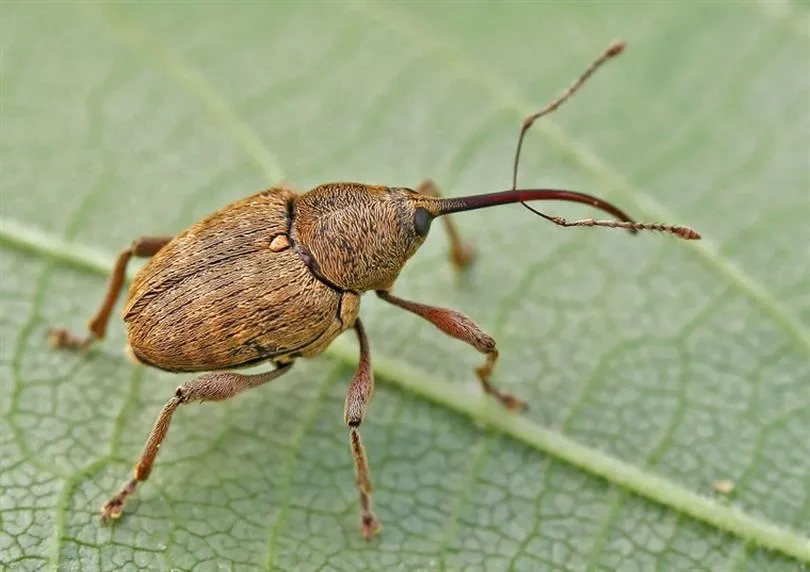
Hazelnut Weevil Control Guide: Identification, Spraying and Prevention
What is the hazelnut weevil (Curculio nucum, formerly Balaninus nucum), its damage symptoms, life cycle and control methods. Spray timing and dosages.
Hazelnut Spraying Calendar: Annual Program for All Pests
Hazelnut orchard spraying calendar: spray timings, dosages and rules against all pests and diseases from February to October.
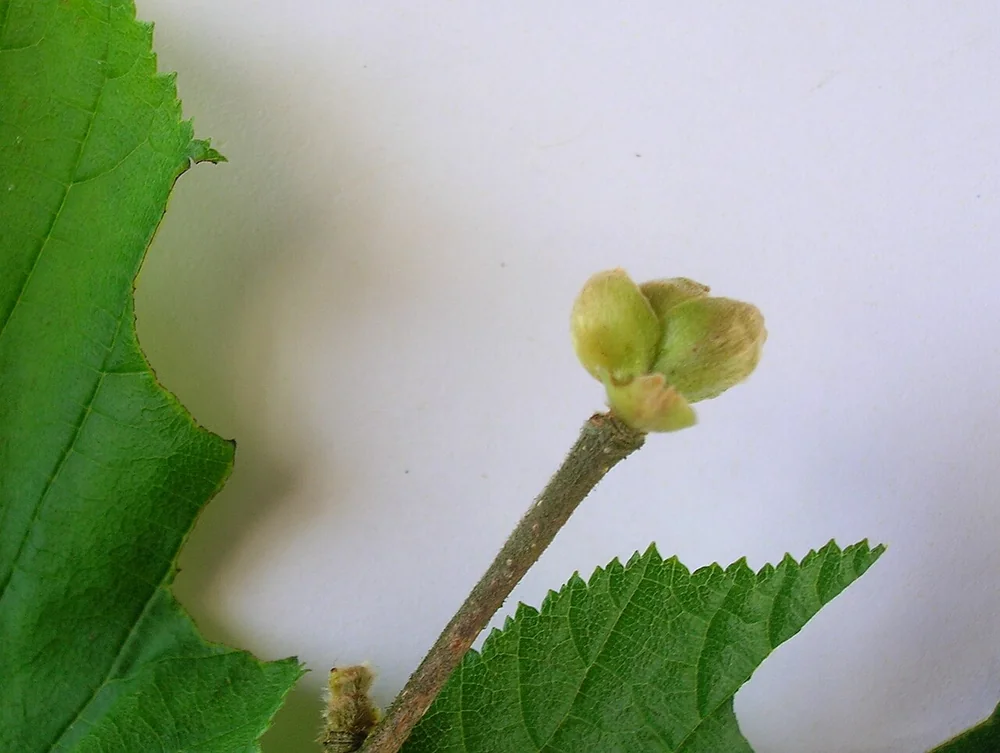
Hazelnut Big Bud Mite (Phytoptus avellanae): Symptoms and Spray Timing
Hazelnut big bud mite: buds swelling into galls, catkin drop and up to 70% yield loss. Spray in the one-week window at the end of April; threshold is 5 big buds per branch. Tombul is most susceptible.
Hazelnut Growing Guide: From Planting to Harvest, Step by Step
A complete guide to growing hazelnuts. Pruning, fertilization, pest control, harvest and market knowledge — everything a hazelnut grower needs on a single page.
More Pest Control Guides
Fall Webworm on Hazelnut (Hyphantria cunea): Web Nests and Control
Fall webworm: silken web nests under the leaves, foliage eaten down to the midrib. Two to three generations a year; spray while the webs are new. Cutting and burning the nests is the most effective method.
Hazelnut Shoot Moth (Gypsonoma dealbana): Symptoms and Spray Timing
Hazelnut shoot moth: triangular brown patches on the leaf and dying shoots. Spraying is done after harvest, finishing by the end of September. Threshold: 15 feeding marks per 100 leaves.
Hazelnut Gall Midge (Mikomyia coryli): Symptoms and Spray Timing
Hazelnut gall midge: galls along the leaf veins, on the husk cluster and at shoot tips. Spray when shoots carry two leaflets, late March to early April, repeated 20 days later. Threshold 50% infestation.
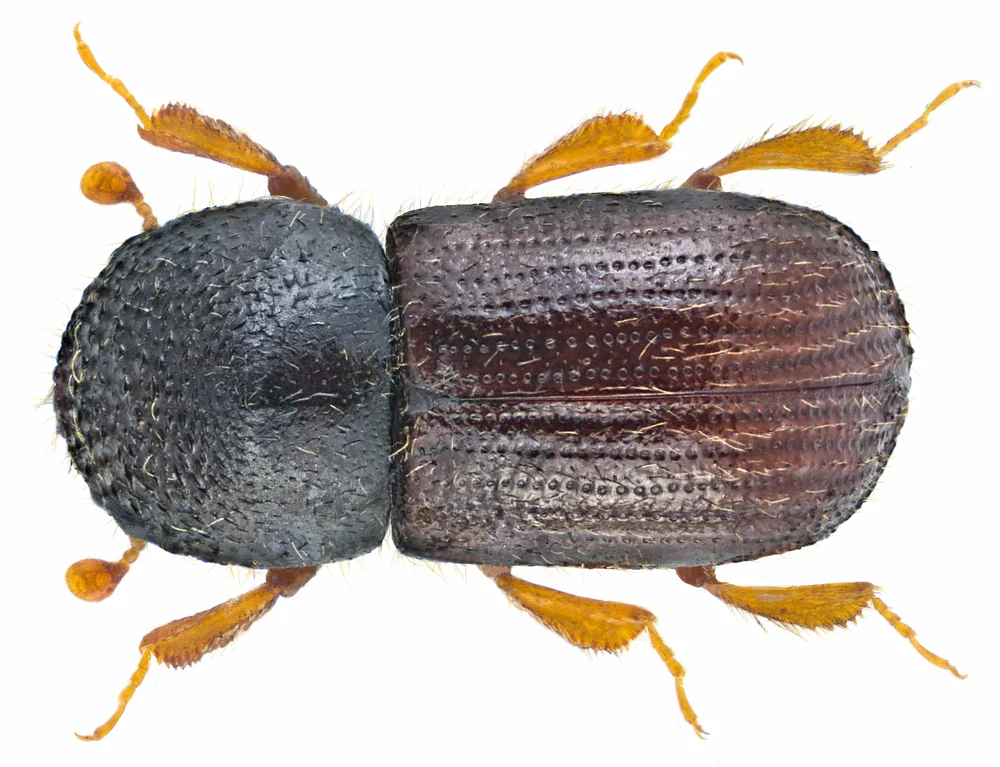
Hazelnut Shot-Hole Borer (Xyleborus dispar): Symptoms, Traps and Spray Timing
Hazelnut shot-hole borer / dalkıran (Xyleborus dispar): 2 mm holes in the branch and seeping sap. When to hang red sticky traps, why the spray goes on in early July, and why whole bushes die.