What Is DAP (Diammonium Phosphate)?
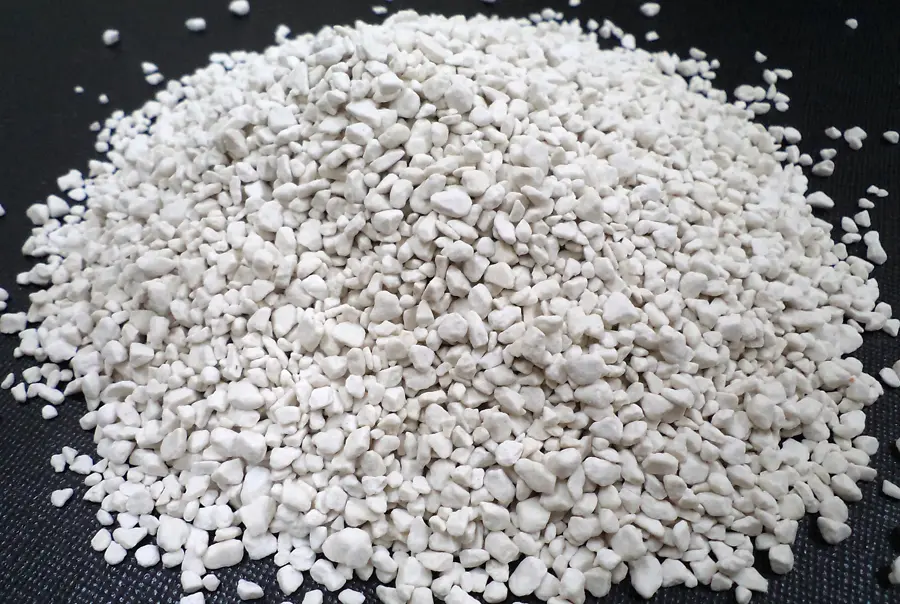
DAP — diammonium phosphate, chemical formula (NH₄)₂HPO₄ — is a granular compound fertilizer. It is the most widely used base fertilizer in Türkiye and is sold under the grade 18-46-0:
- 18 → 18% nitrogen (N), in ammonium form (NH₄-N)
- 46 → 46% phosphorus pentoxide (P₂O₅), fully water soluble
- 0 → contains no potassium
Supplying both phosphorus and nitrogen in a single product, holding its nitrogen in ammonium form (so it does not volatilise the way urea does) and spreading easily thanks to its granular structure have made DAP the classic “winter fertilizer” of hazelnut orchards.
| Property | Value |
|---|---|
| Formula | (NH₄)₂HPO₄ — 18-46-0 |
| Nitrogen (N) | 18%, ammonium nitrogen |
| Phosphorus (P₂O₅) | 46%, water soluble |
| Potassium (K₂O) | None |
| Water solubility | 588 g/L (20 °C) |
| Solution pH | 7.5 – 8.0 (temporary, around the granule) |
| Physical form | Granular |
Why 'Di'-ammonium?
Reacting phosphoric acid with one molecule of ammonia gives monoammonium phosphate (MAP, 12-61-0); reacting it with two gives diammonium phosphate (DAP, 18-46-0). That second ammonium molecule raises the nitrogen content, slightly lowers the phosphorus content, and flips the reaction of the solution from acidic to alkaline.
What Does Phosphorus Do in Hazelnut?
Phosphorus is discussed less often than nitrogen in hazelnut, but its shortage is the most insidious:
- Root development: It builds the fibrous root system, above all during the young-tree stage. A seedling short of phosphorus cannot anchor itself or withstand drought.
- Flower bud formation: Critical for the buds that determine next season’s crop.
- Energy metabolism: It is a building block of ATP and carries photosynthetic energy through the plant.
- Kernel fill and winter hardiness: Supports kernel ratio, lignification and cold tolerance.
Typical deficiency symptoms are dark green to purplish leaves, weak shoots and poor roots. But by the time you see them the tree has already lost yield — diagnosis belongs to the soil test, not to the eye.
Is Phosphorus Really Short in Black Sea Soils?
In most orchards, yes. A survey of hazelnut orchard soils in Ordu and Giresun found the soils to be generally acidic and insufficient in available phosphorus (Ay and Kızılkaya, 2022). A study in Ünye recorded phosphorus deficiency in 35% of soil samples (Akgün et al., 2021). Across Ordu province, roughly 49% of orchard soils fall into the “low” and “very low” classes for plant-available phosphorus (Tarakçıoğlu et al., 2017).
The Real Problem: Phosphorus Fixation in Acid Soils
In hazelnut orchards the phosphorus problem is rarely “there is none in the soil”. It is that the phosphorus present cannot reach the plant. This is called phosphorus fixation.
The leached, acidic soils of the Black Sea region are rich in free iron (Fe) and aluminium (Al) ions. Phosphate ions applied to such a soil combine with them into iron and aluminium phosphate compounds that are almost completely insoluble. The fertilizer has entered the soil, but the plant cannot take it up.
The scale of the loss is not small: the literature reports that only 10-30% of applied phosphorus is usable by plants, while the remaining 70-90% is fixed. The same source stresses that three things govern how much is fixed: the type and rate of the fertilizer, whether it is powdered or granular, and how it is placed in the soil (Tarakçıoğlu et al., 2017).
Those three factors explain every practical rule of DAP use:
- Granular beats powder: A granule keeps the contact surface with soil small; powder clings to every soil particle and is fixed faster.
- Localised beats broadcast: Concentrating the fertilizer in a small soil volume saturates the fixation capacity of that volume, leaving soluble phosphorus for the roots.
- Correct the pH: As soil pH rises, free Fe and Al ions decline and phosphorus availability improves. This is why liming is a precondition for phosphorus fertilization.
Never Apply Lime and Phosphorus Fertilizer Together
The Hazelnut Research Institute’s farmer training leaflet is explicit: “Lime and phosphorus fertilizers must not be applied at the same time.” Lime goes on in November-December, spread onto a 30-40 cm wide circular band at the canopy drip line and worked into the soil; phosphorus fertilizer belongs to a separate operation. If your soil test shows a pH below 5.5, plan liming first — most of the DAP applied to an unlimed acid soil is wasted.
The pH Behaviour Around a DAP Granule
DAP has a little-known property that matters greatly in hazelnut: as the granule dissolves in soil moisture it creates a temporarily alkaline micro-zone around itself, since a DAP solution has a pH of 7.5 – 8.0. As soil bacteria convert the ammonium to nitrate, that pH falls again — the effect is local and lasts a few weeks, not permanently.
For acidic Black Sea soils this is an advantage: immediately around the granule, phosphorus binding to Fe and Al slows down for a while, buying the roots time to find the fertilizer.
The same property has a risky side. In a micro-zone above pH 7 the ammonium can convert to free ammonia (NH₃) and scorch tender roots sitting right against the granule. This is why DAP is never placed in direct contact with roots.
DAP, Urea Phosphate or TSP: Which Fits Which Situation?
All three are phosphorus sources, but they behave differently. The pair most often confused is DAP (18-46-0) and urea phosphate (18-44-0); both carry 18% nitrogen, so the names look alike while the products do not.
| Property | DAP (18-46-0) | Urea Phosphate (18-44-0) | TSP (Triple Superphosphate) |
|---|---|---|---|
| Phosphorus (P₂O₅) | 46% | 44% | 42-46% |
| Nitrogen | 18%, ammonium (NH₄-N) | 18%, urea (NH₂-N) | None |
| Physical form | Granular | Powder / crystal | Granular |
| Water solubility | High (588 g/L) | Fully soluble | Over 90% of the P is soluble |
| pH around the granule | Alkaline (7.5-8.0) | Acidic micro-zone | Acidic micro-zone |
| Drip irrigation | Not suitable | Excellent | Not suitable |
| Main use | Winter base fertilizer, pre-planting | Fertigation, foliar, soil | Base fertilizer when only P is needed |
| Where it stands out | Acid soils, when nitrogen is also required | Drip systems; calcareous/alkaline soils | Nitrogen already sufficient, only P short |
A Practical Decision Rule
If you have a drip system → choose urea phosphate 18-44-0; it dissolves completely. If you fertilize the traditional way in winter and also need nitrogen → DAP 18-46-0. If your soil test shows a phosphorus shortage but no nitrogen shortage → TSP, because it adds no unnecessary nitrogen. The three do not do the same job; the choice depends on your application method, your soil pH and your nitrogen requirement.
When Is DAP Applied in Hazelnut?
Phosphorus is immobile in soil. Unlike nitrogen it does not wash down to the root zone with rain; it stays where it was placed. Two consequences follow: apply it early, and apply it at the depth where the roots actually are.
The official recommendation is unambiguous: “Because phosphorus fertilizers generally show a long-lasting effect in the soil, they are used once every three years during the November-February period, at the rates recommended by leaf and soil analysis results.” (Sakarya Provincial Directorate, Fertilization in Hazelnut)
| Period | Operation | Note |
|---|---|---|
| November – February | Main DAP application | Every 2-3 years, per soil test |
| November – December | Liming (if required) | Not at the same time as phosphorus |
| ~1 month before planting | Base fertilizer in the planting hole | Per soil test |
| March / late May | Nitrogen applications | DAP’s nitrogen does not cover this |
Applying phosphorus every year is a common but mistaken habit. Phosphorus accumulation blocks zinc and iron uptake — the zinc-phosphorus antagonism is a known problem in hazelnut.
How to Apply: Placement, Not Broadcasting
One sentence from the Hazelnut Research Institute leaflet sums it up: “When fertilizing hazelnut, the fertilizer must be applied to the canopy drip line (in a band).”
The official method for phosphorus fertilizer is this: the fertilizer is distributed evenly into 16-32 holes opened under the drip line according to bush size, and the holes are covered with soil. For hole depth the Hazelnut Research Institute leaflet gives 10-15 cm and the Sakarya Provincial Directorate leaflet 15-20 cm; in practice the 10-20 cm layer is where hazelnut’s fine roots are concentrated.
✓ DAP Application Steps
- ✓ Have your soil test report and its recommended pure P₂O₅ rate to hand
- ✓ Mark the canopy drip line (where the branches end) — not the trunk base
- ✓ Open 16-32 holes along that line, depending on bush size
- ✓ Keep hole depth at 10-20 cm; this is the fine-root zone
- ✓ Divide the calculated DAP quantity equally among the holes
- ✓ Always cover the holes with soil afterwards
- ✓ On sloping land roots spread further downslope; distribute the holes accordingly
- ✓ If liming is needed, do it in a separate operation, never together with DAP
Why broadcasting falls short. Phosphorus broadcast on the surface does not migrate downward; it stays in the top few centimetres and is bound there by iron and aluminium, never reaching root depth. Broadcasting is reserved for nitrogen fertilizers, spread onto a 30-40 cm wide circular band at the drip line and mixed into 3-5 cm of soil.
DAP at Planting Time
Phosphorus pays back most at orchard establishment; once the tree is planted, placing phosphorus deep in the root zone becomes very difficult.
According to the Hazelnut Research Institute’s growing guide, in the bush (ocak) planting system holes are opened at least one month before planting, 120 cm wide and 60 cm deep; for hedge planting 50 cm wide and 30-40 cm deep is enough. Before planting begins, “the farmyard manure, phosphorus and potassium fertilizers and liming recommended by the soil analysis” are applied.
Keep DAP Away From Seedling Roots
As a DAP granule dissolves it forms an alkaline micro-zone of around pH 7.5-8; under those conditions ammonium can turn into free ammonia and scorch tender roots (Mosaic Crop Nutrition). Therefore:
- Mix the DAP thoroughly with the subsoil of the hole; never pour it by hand onto the roots
- Cover it with unfertilized topsoil so the seedling roots sit in that clean layer
- Do not pile unrotted farmyard manure and DAP in the same hole; water generously after planting
For the nitrogen needs of newly planted trees the Hazelnut Research Institute recommends 40 g of 26% calcium ammonium nitrate (CAN) per seedling, half in early March and half in late May-early June. See our calcium ammonium nitrate guide for details.
How Is the Rate Calculated?
A soil test report gives you not a quantity of fertilizer but the pure P₂O₅ to be applied per decare. Converting it into bags is a simple division:
DAP quantity (kg) = recommended pure P₂O₅ (kg) ÷ 0.46
You also have to account for the nitrogen that comes with it:
Pure nitrogen supplied (kg) = DAP quantity (kg) × 0.18
| Pure P₂O₅ recommended in the report | DAP required | Pure N supplied with it |
|---|---|---|
| 4 kg/decare | 8.7 kg | 1.6 kg |
| 6 kg/decare | 13.0 kg | 2.3 kg |
| 8 kg/decare | 17.4 kg | 3.1 kg |
| 10 kg/decare | 21.7 kg | 3.9 kg |
The figures in the table are arithmetic conversions only, not rate recommendations. Which row applies to you is decided by your soil test report.
Who Decides the Rate?
No number on this page is a rate recommendation for your orchard. The exact rate depends on your soil analysis result; consult your provincial or district directorate of agriculture, or an agricultural engineer — the directorates provide free soil analysis and fertilizer advice to growers. For sampling method, see our soil analysis guide.
Nitrogen balance: The nitrogen DAP brings is a small share of the annual requirement and it arrives in winter. The real nitrogen demand is met in two split applications, in March and in late May-early June, with ammonium sulfate, calcium ammonium nitrate or urea.
Potassium: DAP contains none; the requirement is best covered with potassium sulfate, since hazelnut is chloride-sensitive. According to the Sakarya Directorate leaflet, potassium fertilizer may go into the same holes if it is applied together with phosphorus.
Common Mistakes
- Applying phosphorus every year without a soil test. Phosphorus is applied every 2-3 years; annual applications accumulate and disturb zinc and iron uptake.
- Broadcasting DAP on the surface. Phosphorus is immobile; left on top, it never reaches the roots.
- Dumping it at the trunk base. The fine feeder roots are concentrated at the drip line; fertilizer at the trunk is useless and risks root burn.
- Applying it together with lime. The official leaflet warns against this explicitly; separate the two operations in time.
- Letting it touch seedling roots. The alkaline micro-zone and free ammonia scorch fresh roots; keep clean soil between root and fertilizer.
- Trying to use it in drip irrigation. Its granular structure and fillers clog emitters; fertigation needs fully soluble products.
- Treating DAP as a complete fertilizer. 18-46-0 has no potassium, and its nitrogen is only a small part of the annual need.
- Applying phosphorus without correcting pH. Hazelnut grows well between pH 5 and 7; at a lower pH most of the applied phosphorus is fixed.
Summary
- DAP = 18% nitrogen (ammonium) + 46% phosphorus, a granular base fertilizer
- Main window November-February, frequency every 2-3 years, decided by the soil test
- Placed in 16-32 holes at the drip line, 10-20 cm deep; broadcasting does not work for phosphorus
- In acid soils most phosphorus is bound by Fe/Al; localised placement and liming reduce the loss
- The temporary alkaline micro-zone is an asset in acid soil and a risk next to fresh roots
- At planting, mix it with the hole’s soil and keep it off the roots
- With drip irrigation choose urea phosphate 18-44-0; without it, DAP
- Potassium and the remaining nitrogen come from separate fertilizers
For the full annual calendar see our hazelnut fertilization programme, and for sampling and reading results our soil analysis guide.
📚 Hazelnut Research Institute - Fertilization in Hazelnut 📚 Sakarya Provincial Directorate of Agriculture and Forestry 📚 Hazelnut Research Institute - Hazelnut Growing Techniques 📚 Tarakçıoğlu et al. (2017), Ordu Univ. J. Sci. Tech. 📚 Ay and Kızılkaya (2022), J. Soil Science and Plant Nutrition 📚 Akgün et al. (2021), Turkish J. Agricultural and Natural Sciences 📚 Mosaic Crop Nutrition - Diammonium Phosphate📚Sources
- Republic of Türkiye Ministry of Agriculture and Forestry - Hazelnut Research Institute, Fertilization in Hazelnut (Farmer Training Series No: 4)
- Sakarya Provincial Directorate of Agriculture and Forestry - Fertilization in Hazelnut
- Hazelnut Research Institute - Hazelnut Growing Techniques
- Tarakçıoğlu C., Yılmaz İ., Kulaç S. (2017) - Plant Available Phosphorus in Hazelnut Orchard Soils, Ordu Univ. J. Sci. Tech. 7(2)
- Ay A., Kızılkaya R. (2022) - Plant Nutrient Contents of Hazelnut Orchard Soils in Ordu and Giresun, Journal of Soil Science and Plant Nutrition
- Akgün M., Ete Aydemir Ö., Özkutlu F. (2021) - Phosphorus Nutrition Status of Hazelnut Orchards in Ünye, Turkish Journal of Agricultural and Natural Sciences 8(4)
- Mosaic Crop Nutrition - Diammonium Phosphate (DAP)
Related Guides
View all Fertilization guides
Urea Phosphate 18-44-0 Fertilizer: Usage and Benefits in Hazelnut
What is urea phosphate 18-44-0 fertilizer and how is it used in hazelnut orchards? Application timing, dosage calculation, differences from DAP, and key considerations.
Hazelnut Fertilization Program: Annual Schedule and Application Rates
When to fertilize hazelnuts, which fertilizer types to use, and how much per decare. A practical guide to nitrogen, phosphorus, potassium and organic fertilizer applications.
Soil and Leaf Analysis Guide for Hazelnut Orchards
When to have a soil analysis done in a hazelnut orchard, how to take the sample, and how to read the results. Leaf analysis timing and method explained.
Potassium Sulfate (0-0-51) Fertilizer: Use and Dosage in Hazelnuts
What is potassium sulfate fertilizer, and when and how should it be used in hazelnuts? Learn about 51% K2O and 18% sulfur content, dosage, application timing, and important considerations.
More Fertilization Guides
Ammonium Nitrate (33-0-0): Use, Dosage and Leaching Risk in Hazelnuts
What is ammonium nitrate fertilizer and how is it used in hazelnuts? The 16.5% ammonium + 16.5% nitrate balance, how it differs from CAN, behaviour on acid soils, nitrate leaching and dose calculation.
Ammonium Sulfate (21-0-0) Fertilizer: Use in Hazelnuts and the Acidity Risk
What is ammonium sulfate fertilizer, and when and how should it be used in hazelnut orchards? 21% nitrogen + 24% sulfur, dosage logic, soil acidification risk and a comparison with CAN.
Boron Fertilization in Hazelnuts: Blank Nuts, Dosage and Toxicity Risk
What does boron do in hazelnuts, and does a deficiency cause blank nuts? Critical boron values in soil and leaf analysis, soil and foliar application rates, and the risk of boron toxicity.
Farmyard Manure and Organic Matter in Hazelnut Orchards: Building the Foundation
What does farmyard (barn) manure do in a hazelnut orchard, what is well-rotted manure, when and how is it applied? The role of organic matter in holding water and nutrients, husk compost and common mistakes.